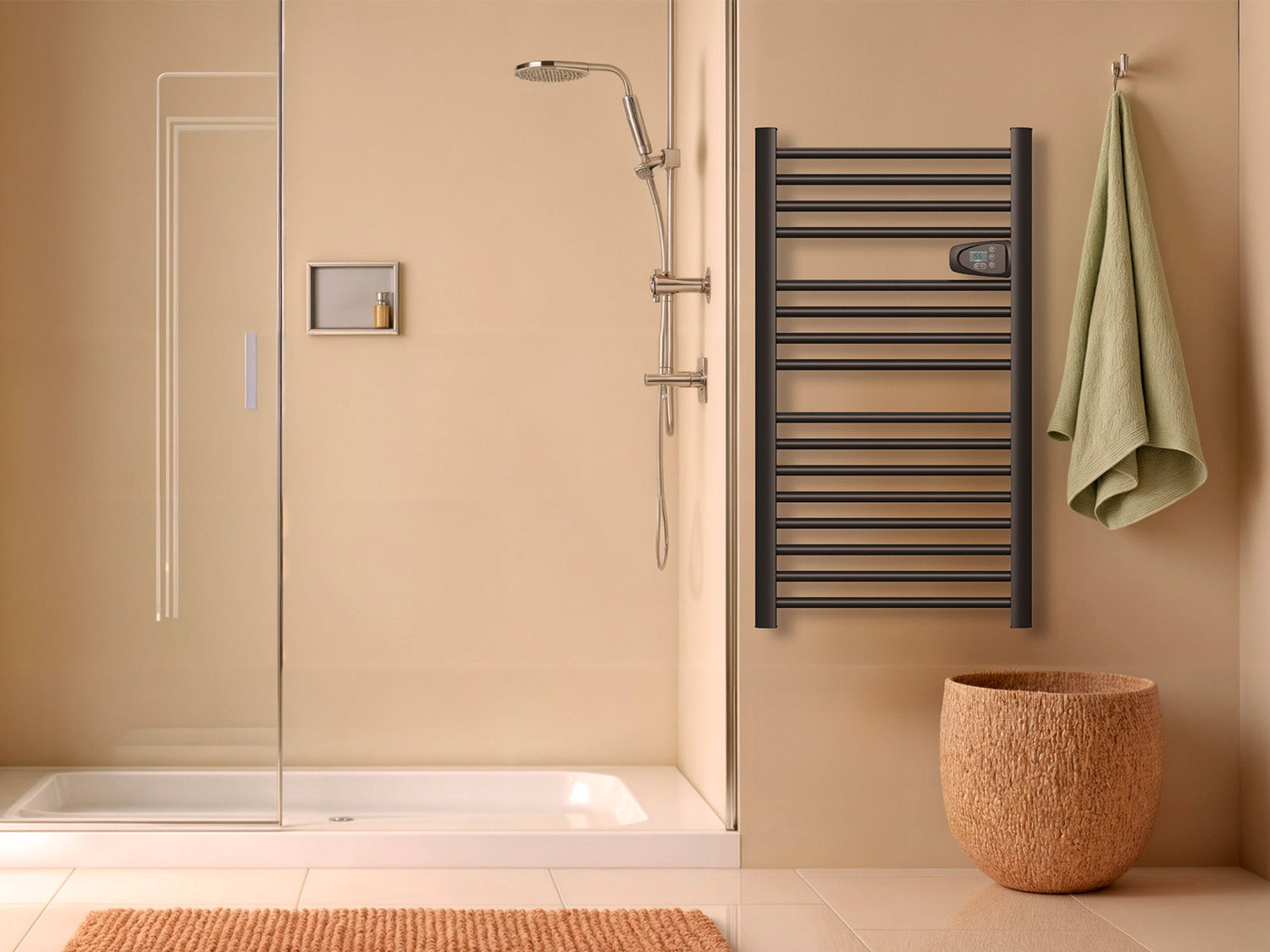
Do you want to install a heated towel rail with dry inertia in your bathroom? This Bestherm guide will walk you through a successful, durable, and compliant installation to enjoy optimal thermal comfort every day.
The importance of a compliant and safe installation.
Requirements of the NFC 15-100 standard
A poorly installed heated towel rail can compromise safety, reduce the device’s lifespan, and impair its thermal performance. It is essential to respect safety distances, regulatory volumes, and the electrical instructions of the NFC 15-100 electrical standard
Choose the right location for your heated towel rail
Safety distances to respect in a bathroom
The correct placement of your heated towel rail is essential to ensure safety and performance. For compliant installation, it is recommended to:
- Install the device at least 60 cm away from any water source
- Position the bottom of the device at least 60 cm from the floor to optimize the sensor’s operation
- Mount the device on a dry, healthy, and solid wall, protected from direct splashes and drafts.
All Bestherm heated towel rails are suitable for bathrooms thanks to their Class II (double insulation) and IP24 protection rating, ensuring optimal resistance to water splashes.

Safe electrical connection of your heated towel rail
An electric heated towel rail must never be plugged into a standard wall socket. It must be connected directly to a secure cable outlet, in accordance with NFC 15-100 standard.
Before connecting, it is essential to follow these instructions:
- Turn off the power at the main circuit breaker
- Use a 3-wire cable with the following color codes:
- Blue or light gray: Neutral
- Brown or red: Live wire
- Black: Pilot wire (optional, for programming)
- Connect in a wall box, never on an electrical outlet
- Protect the circuit with a 30 mA residual current circuit breaker
- Never connect the pilot wire to the ground, and insulate it if it is not used

💡 Bestherm advice: when in doubt, call a qualified electrician.
Install the heated towel rail away from water points
The NFC 15-100 electrical standard defines several safety volumes around water points, which determine the types of electrical devices allowed in each zone. These volumes ensure user safety by limiting the risks of contact with water and splashes, especially in bathrooms:
| DEVICES | PROTECTION MEASURE | VOLUME 0 (IPX7) | VOLUME 1 (IPX5) | VOLUME 2 (IPX4) | OUTSIDE VOLUME |
| Electric heating | Class I | Prohibited | Prohibited | Prohibited | Allowed |
| Electric heating | Class II | Prohibited | Prohibited | Allowed | Allowed |

Need help installing your heated towel rail?
Do you have questions or want personalized support? Our customer service is available at the following address: service.clients@hom-y.fr
To ensure a compliant and safe installation, we recommend hiring a qualified professional electrician.
FAQ: Installing an electric heated towel rail in a bathroom
How far from a shower or bathtub should a heated towel rail be installed?
To comply with the NFC 15-100 standard, it is recommended to install a heated towel rail at least 60 cm away from water points.
This distance helps limit risks related to water splashes and ensures the safe use of the device in the bathroom.
Can an electric heated towel rail be plugged into a power outlet?
No. An electric heated towel rail should never be connected to a standard wall socket.
It must be connected directly to a dedicated cable outlet protected by an appropriate device, in accordance with the requirements of the NFC 15-100 standard.
Which heated towel rail should you choose for a bathroom?
For safe installation, it is recommended to choose a Class II heated towel rail (double insulation) with a minimum protection rating of IP24.
These features ensure appropriate protection against water splashes and allow for compliant installation in the authorized areas of the bathroom.