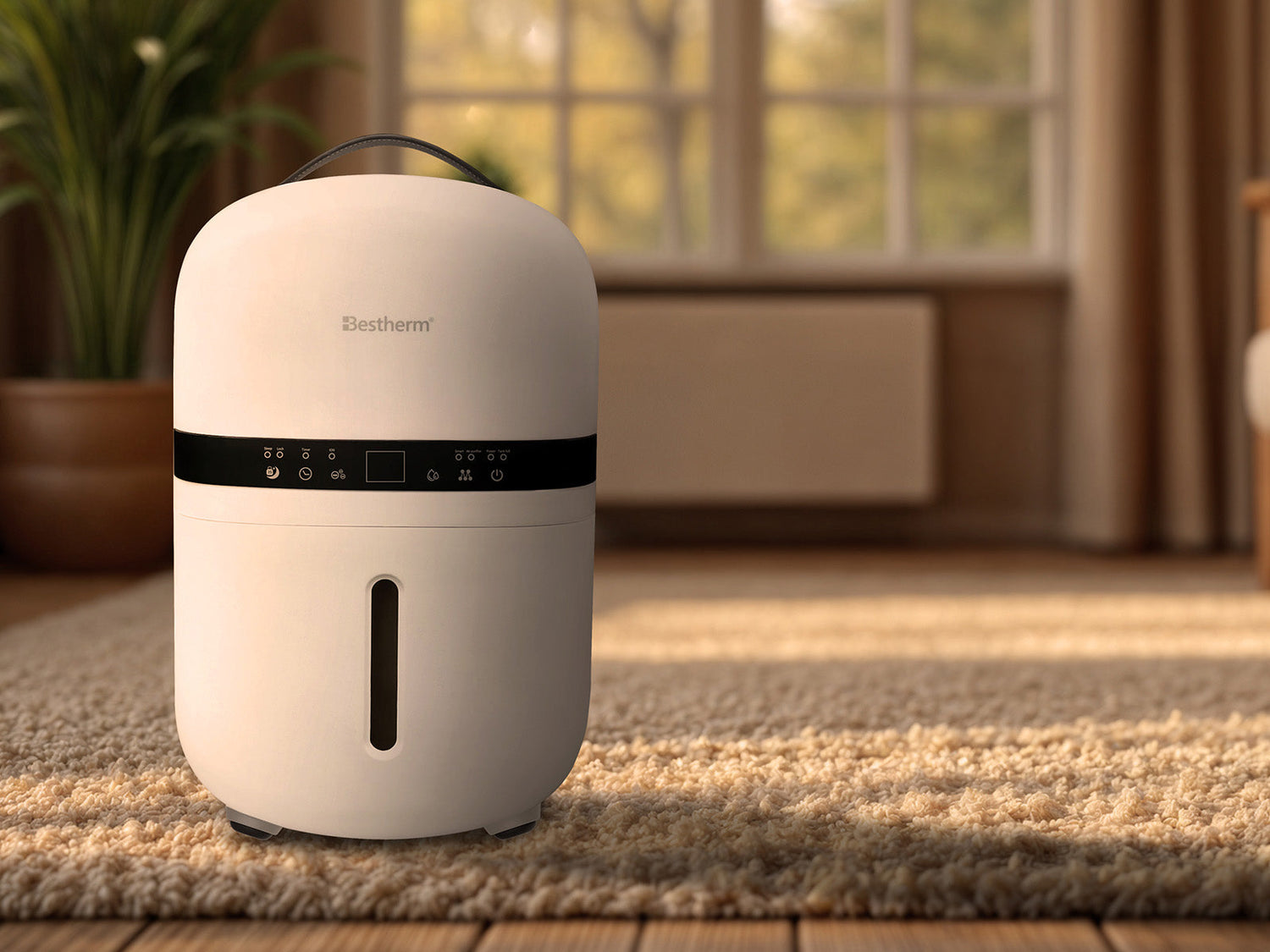
Do you notice persistent humidity in your home? Musty smell, laundry drying poorly, or condensation on windows: these are all signs that your humidity level is probably too high. To restore a healthy interior, an air dehumidifier can be the ideal solution. But how to choose the most suitable model? Bestherm guides you step by step for healthier, more comfortable air.
Why regulating humidity in your home is essential
Risks of too high humidity levels
Excessive humidity is not only unpleasant, it can also be dangerous for your health and your home. According to ADEME*, the ideal humidity level is between 40% and 60%.
Too much humidity promotes:
- The appearance of mold and fungi
- Condensation on walls and windows
- Bad odors
In the long term, these conditions can cause respiratory problems, allergies, and damage to your home’s walls or furniture.
How to reduce humidity in your home daily?
Simple steps to limit humidity
Before investing in a dehumidifier, some simple actions can reduce your home’s humidity level:
- Air out regularly, especially after showering, laundry, or cooking.
- Cover your pots and use the extractor hood to limit steam.
- Dry laundry outside or in a well-ventilated room.
- Properly insulate and ventilate your home: a good ventilation system and efficient windows make a big difference.
- Additionally, a dehumidifier effectively dries the air and improves your comfort.
How to choose your dehumidifier: criteria to consider
To choose the right dehumidifier, several criteria must be considered:
- Dehumidification capacity: expressed in liters per day, it defines the device’s effectiveness.
- Room size: expressed in m³, it helps choose a model capable of properly treating the air in the space.
By following these criteria, you optimize your device’s efficiency while ensuring healthy and comfortable air.
Comparison of Bestherm dehumidifiers
| PRODUCT | CAPACITY (L/day) | POWER | TREATED AREA (m³)3) |
| NOVA 5L | 5L | 155W | 80 - 120 m³ |
| KERIA 10L | 10L | 165W | 160 - 215 m³ |
| ILLA 12L | 12L | 185W | 160 - 215 m³ |
| ATHEA 20L | 20L | 270W | 220 - 290 m³ |
| FERYEL 24L | 24L | 305W | 220 - 290 m³ |
Improve indoor air quality
All our dehumidifiers also have a slot to insert an activated carbon filter and a HEPA 13 filter, to improve air quality in addition to regulating humidity.
Thanks to this filtration system, our devices offer a double benefit: limiting excess humidity while helping to purify the air in your home.
Where to install a dehumidifier for optimal efficiency?
Best installation practices
To ensure maximum efficiency, follow these recommendations:
- Place the device in a closed room (windows and doors closed during operation).
- Leave at least 20 cm of clearance around and 50 cm above the device for optimal air circulation.
- Avoid outdoor installations or areas that are too ventilated.
- Make sure the ambient humidity level does not exceed 80% for safe and effective operation of the device.
Find the model suited to your home
With Bestherm, you benefit from healthier air and a more comfortable interior. Whether you are looking for a discreet model for a bedroom or a powerful dehumidifier for large rooms, our range adapts to all needs.
FAQ: Everything you need to know about dehumidifiers
Which dehumidifier to choose for a house or apartment?
The choice mainly depends on the volume of the room to be treated and the level of humidity present in the home.
For a small room, a model with a capacity of 5 to 10 liters per day may be sufficient, while larger rooms or very humid homes require a more powerful dehumidifier capable of extracting 20 liters per day or more.
Can a dehumidifier help fight mold?
Yes. By reducing excess moisture in the air, a dehumidifier limits conditions favorable to the growth of mold, fungi, and condensation.
It helps preserve air quality and protect walls, ceilings, and furniture.
Where to place a dehumidifier for the best results?
For optimal efficiency, it is recommended to install the dehumidifier in a closed room, leaving enough space around the device to allow good air circulation.
Focus on the room where humidity problems are most noticeable, such as condensation on windows, persistent odors, or difficulty drying laundry.
* Environment and Energy Management Agency
** https://agirpourlatransition.ademe.fr/particuliers/proteger-sante/eviter-polluants/respirer-air-sain-chez-soi