
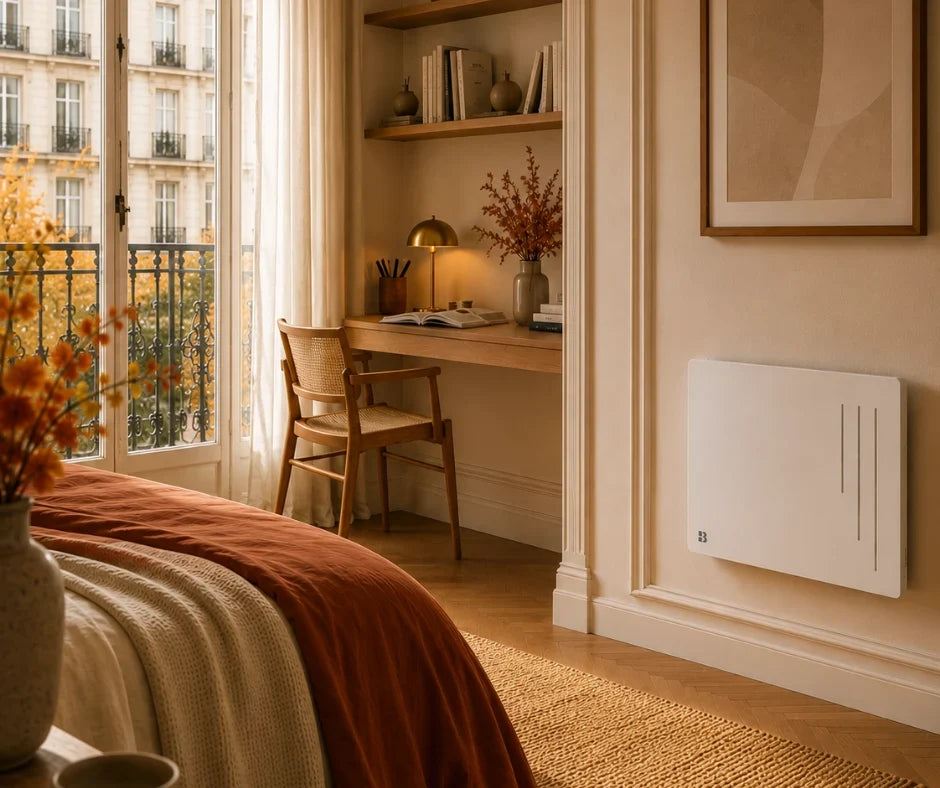
The first chilly mornings are back. Is it already time to turn the heating back on, or is it better to wait a few more days? In reality, there is no ideal date that suits every home: a recently built, well-insulated apartment does not react in the same way as an older house, which is often more sensitive to temperature fluctuations.
Between the last days of summer and the first cold spells, it is not always easy to know when to turn the heating back on. During this transition period, needs vary throughout the day and from one room to another. There is therefore no need to heat the entire home continuously.
Electric radiators with weekly programming make this easier by automatically adjusting the temperature according to your lifestyle.
What is the ideal date to turn on the heating in autumn?
There is no legal date requiring the heating to be turned on in an individual home. Contrary to popular belief, there is no obligation to wait for a specific date before turning your radiators back on.
In practice, the heating season generally begins around mid-October, when outdoor temperatures drop steadily. However, the calendar is only indicative: a well-insulated home will retain more heat than a property exposed to heat loss.
It is better to rely on the indoor temperature than on the calendar. If your home naturally remains around 19°C during the day, there is no need to turn all the appliances back on immediately.
Individual vs. central heating: which rules apply?
In a home equipped with individual heating, the occupant remains free to decide when to turn the radiators on or off according to their needs and comfort. They can adjust the set temperature room by room to avoid unnecessary consumption.
In a building with central heating, switching it on generally depends on a decision by the co-owners or on the rules governing the shared system. The usual period is often between October 15 and April 15, although these dates may vary depending on the climate.
The Building and Housing Code* sets out, in particular, requirements relating to the thermal comfort of buildings, but it does not establish a single national date for turning on the heating in all homes.
The weather rule: the impact of outdoor temperatures
The main indicator for knowing when to turn on the heating remains the evolution of outdoor temperatures. A sustained drop is generally more representative than a simple cold spell lasting a few days.
It is often considered appropriate to gradually turn the heating back on when outdoor temperatures fall below 12 to 14 °C for several consecutive days.
This approach helps avoid two common mistakes: turning the heating back on after a brief cold snap or, conversely, waiting too long and allowing the home to cool down.
What indoor temperature should you turn your radiators back on at?
The indoor temperature is the best indicator for determining the ideal time to turn your radiators back on. A home can retain a pleasant warmth for several weeks after the heating is switched off, particularly thanks to its insulation and the thermal inertia of its materials.
In practice, many households turn their heating back on too soon after the first cold week of autumn. However, a temporary drop in temperatures does not necessarily mean that the heating season has begun. Monitoring the indoor temperature over several days is often more relevant.
The 19 °C rule recommended by ADEME
According to ADEME**, maintaining a temperature of 19 °C in occupied living areas is a good compromise between comfort and energy consumption. This does not mean that all rooms need to be heated to this temperature: a bedroom or hallway can remain cooler without compromising daily comfort.
During the shoulder season, a dry-inertia electric radiator provides more stable heat than a traditional convection heater, improving comfort while limiting temperature fluctuations.
Humidity: a factor not to overlook for thermal comfort
In autumn, the feeling of cold depends not only on the temperature displayed on the thermostat. Air that is too humid can increase discomfort and make a home feel colder than it really is.
Maintaining a good humidity level therefore helps improve comfort while avoiding overheating. An air dehumidifier can be useful in rooms prone to humidity, such as a bathroom, laundry room, or poorly ventilated home. By reducing excess humidity, it helps create a healthier and more pleasant atmosphere every day.
Adjusting the temperature according to the rooms in your home
Not all rooms in a home have the same needs. A bedroom, bathroom, or living room does not require the same set temperature, particularly because of how long each room is occupied.
- Living areas: prioritize a comfortable temperature when the home is occupied.
- Bedrooms: a cooler temperature generally promotes better sleep.
- Bathroom: a temporary increase in temperature is often more suitable than continuous heating.
- Rooms used infrequently: maintaining a minimum temperature prevents the home from becoming excessively cold.
Smart heating solutions now make it possible to go further thanks to weekly programming and connected thermostats. Heating can thus adapt to lifestyle habits: automatic reduction while away, raising the temperature before returning home, or adjustment room by room.
Comparison table: recommended temperatures and heating times by room
A living room occupied all day and a bedroom used only at night do not have the same needs. Adjusting the temperature room by room is one of the simplest ways to limit consumption without sacrificing comfort.
| Room in the home | Target temperature | Suggested turn-on threshold | Comfort & savings tip |
| Living areas (living room, lounge) | 19 °C | Below 18 °C residual temperature | Program a lower temperature at night or when away. |
| Bedrooms | 16 °C to 17 °C | Below 16 °C residual temperature | Choose a suitable duvet to delay turning on the heating. |
| Bathroom | 21 °C when occupied / 17 °C the rest of the time | Only when in use | Rely on a responsive towel rail heater to heat on demand. |
| Kitchen / Hallways | 17 °C to 18 °C | Below 16 °C residual temperature | Make use of the heat generated by cooking. |
How can you delay turning on the heating without sacrificing comfort?
At the beginning of autumn, it is often possible to delay turning the heating back on fully by adopting a few simple habits. The aim is not to endure the cool temperatures, but to make smart use of the resources already available in the home.
Make use of solar gains and reduce heat loss
Before turning on your heaters, a few habits can help naturally retain heat and limit heating needs:
- Open the shutters as soon as the first rays of morning appear on the south- or east-facing side to benefit from free solar gains.
- Close shutters and thick curtains as soon as night falls to limit heat loss through the windows.
- Air out the rooms for 10 minutes a day to renew the air and remove ambient humidity. Drier air is easier to heat.
- Use door draft stoppers or seal openings prone to drafts to reduce heat loss.
These simple actions can sometimes provide several degrees more perceived comfort without increasing the heaters’ set temperature.
Relying on the responsiveness of electric storage heaters
When temperatures become cooler, an electric storage heater is a suitable solution for making the transition between seasons. Unlike a heating system that operates solely in on/off mode, it distributes heat more evenly thanks to its heating core.
Depending on the model, the heating core is based on dry thermal inertia technology or a heat-transfer fluid. In both cases, the goal remains the same: to deliver gentle, even heat, including between heating cycles.
The performance of electric radiators is also governed by European requirements and specific certifications. The ErP*** Ecodesign directive sets energy-efficiency criteria for energy-related products, while the NF Électricité** certification attests to quality and performance criteria for certain electric heating appliances.
The Bestherm radiators equipped with smart regulation are particularly well suited to transitional periods. With a connected thermostat, weekly scheduling, presence detection, or window-opening detection, it becomes possible to automatically adjust heating according to household routines.
During the first weeks of autumn, this zone-based management avoids turning on the heating throughout the entire home when only one room needs a temporary boost of warmth.
Essential steps before turning your radiators back on
After several months without use, a few checks can quickly restore efficient and comfortable heating.
- Dust the heating elements and ventilation grilles to prevent odors during the first use and optimize heat distribution.
- Check the schedules and thermostats to ensure they match the new autumn timetable. Setting an appropriate target temperature for occupied periods helps avoid unnecessary energy consumption.
- Carry out a gradual heat-up test room by room to check that the appliances are working properly before the first severe cold spells.
Restarting the heating early but in a controlled manner also makes it possible to quickly identify any maintenance needs or settings that need adjustment.
FAQ: When should you turn on the heating?
What is the official date for turning on the heating?
There is no official date requiring individual heating to be turned on. In practice, the heating season often begins around mid-October. In buildings with communal heating, the start-up is decided by the co-owners’ association, generally based on the weather.
If your home remains at a comfortable temperature despite the first cool spells, there is no need to turn your radiators back on immediately. Conversely, when the indoor temperature becomes persistently uncomfortable, it is time to gradually resume heating.
Should you turn on the heating as soon as the temperature drops below 19°C?
Yes, it is advisable to turn the heating back on when the temperature remains below 19°C in living areas. If the drop is temporary, it is better to wait or put on warmer clothing before turning all the heaters back on.
The way you feel also depends on several factors: ambient humidity, insulation quality, the home's exposure, and the presence of drafts. A well-ventilated home with controlled humidity will more easily maintain a comfortable feel.
Is it more economical to leave the heating on at its lowest setting or turn it off completely before winter?
At the beginning of the shoulder season, it is generally more economical to turn off the heating on mild days or use Eco mode. However, allowing a home to cool down completely can require more energy to bring it back up to temperature than maintaining it at around 16 to 17°C.
Connected electric heaters or models with weekly scheduling make this easier by automatically adjusting the temperature according to your lifestyle.
How can you heat the bathroom quickly without turning on the heating throughout the house?
To heat a bathroom quickly without raising the temperature throughout the house, a programmable electric towel radiator is one of the most suitable solutions. It allows the temperature to reach around 21°C only for as long as necessary, without turning the heating back on throughout the home.
A fan-assisted electric towel radiator with scheduling allows you to anticipate the temperature rise before a shower and avoid heating the room unnecessarily for the rest of the day.
Turn on your heating at the right time to limit consumption
Knowing when to turn on the heating does not depend solely on a specific date. The best indicator remains the balance between the outdoor temperature, indoor temperature, and how the occupants feel.
With an electric inertia heater, a well-adjusted thermostat, good humidity management, and a schedule suited to your lifestyle, it is possible to maintain excellent comfort while limiting electricity consumption. By monitoring the temperature in your home and gradually adjusting the heating, you avoid heating unnecessarily while still enjoying a pleasant interior.
* https://www.legifrance.gouv.fr/codes/section_lc/LEGITEXT000006074096/LEGISCTA000041569808/2026-03-12
*** https://www.ecologie.gouv.fr/politiques-publiques/ecoconception-etiquetage-produits-lies-lenergie

