
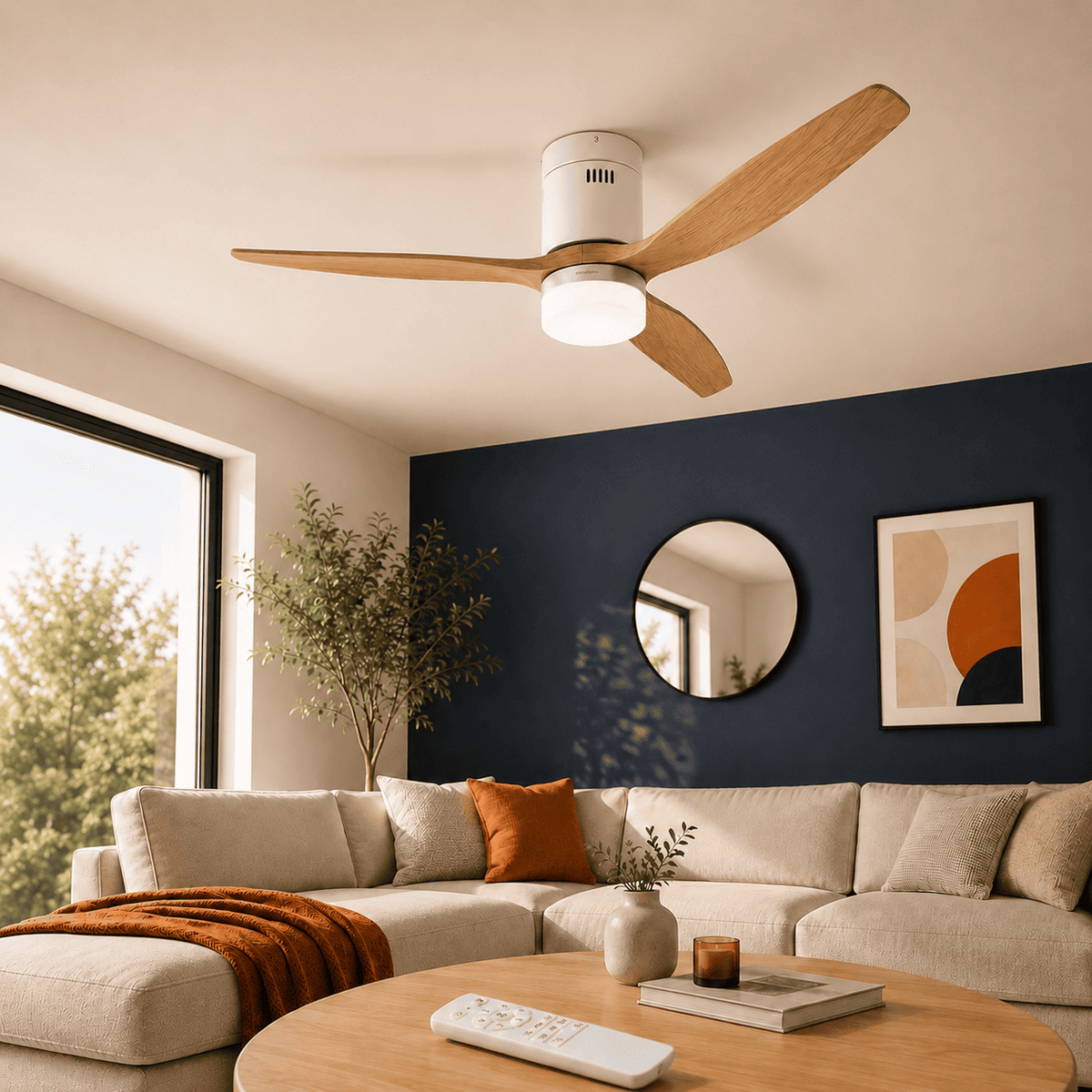
A ceiling fan is much more than a simple decorative feature. When chosen and installed correctly, it improves thermal comfort all year round: it effectively cools in summer, reduces reliance on air conditioning and can even distribute heat more evenly in winter.
In this guide, we will take you through the steps to install your ceiling fan easily and correctly.
What criteria should you consider when choosing the right ceiling fan?
Suitability for your room
The ceiling fan must above all be suited to your space and layout. Ceiling fans with integrated LED lighting are designed to provide excellent air circulation in medium-sized to large living spaces.
Ceiling height
For safety and comfort, the blades must always be at least 2.3 metres above the floor.
- If your ceiling is low (less than 2.6 m), opt for an installation close to the ceiling without a suspension rod.
- For higher ceilings, an extension rod can be used to optimise air distribution.
It is also recommended to leave sufficient clearance around the appliance to ensure good air circulation.
The remote control and practical features
A comprehensive remote control greatly improves everyday comfort. Depending on the model, several features are available:
- Speed adjustment (6 levels)
- Natural breeze mode to simulate a gentle breeze
- Timer (1h, 4h, 8h)
- Delayed shut-off
- Reversing the rotation direction (summer / winter)
- Silent mode to disable sound signals
- 3-colour LED lighting
- Adjusting the light intensity
Some advanced modes, such as anti-intrusion mode, can even simulate someone being home by automatically switching the light and ventilation on at regular intervals.
Installation: what you need to know before getting started
Electrical requirements
Installing a ceiling fan is an electrical task that requires a few essential precautions:
- Always switch off the power at the main circuit breaker before carrying out any work.
- The fan must be connected to a dedicated electrical circuit, protected by a double-pole circuit breaker, in accordance with current standards (NF C15-100 in France).
- The appliance must be powered through a residual-current device (RCD) with a rated residual operating current not exceeding 30 mA.
- Never use a dimmer switch or wall-mounted speed controller with a ceiling fan: this poses a risk of electric shock and fire.
If you are not comfortable with electrical wiring, call a qualified electrician.
Tools required
For a standard installation, prepare:
- Phillips screwdriver and flat-head screwdriver
- Wire stripper
- Electrical insulating tape
- A stable stepladder
Installation steps
1. Attaching the mounting plate
Depending on the type of ceiling:
- Concrete ceiling: drill 2 holes at the marked locations on the plate, then insert 2 expansion anchors.
- Wooden ceiling: use 4 long self-tapping screws.
Pass the recessed wire and the earth wire through the central hole in the plate before securing it.
2. Electrical connection: First connect the motor and light wires to the control unit (remote control receiver), then connect the mains wiring:
| Wire | Connection |
|---|---|
| Blue or light gray | N (Neutral 230 V) |
| Brown or red | L (Live 230 V) |
| Yellow/green | Protective earth |

3. Attaching the fan body: Align the motor's side holes with those in the mounting plate and secure it using the supplied screws.
4. Installing the blades: Install the three blades using a screwdriver, tightening the screws evenly and simultaneously to ensure the assembly remains balanced.
5. Installing the light kit: Pass the light source cable through the hole in the panel, secure the panel, connect the LED, then insert and turn the lampshade to lock it in place.
6. Powering on: Once all connections have been checked, switch the circuit back on.
Blade balancing: an often-overlooked step
A fan that vibrates or oscillates is not only bothersome—it can also indicate an imbalance that, over time, places strain on the ceiling mounting. The installation kit includes a balancing clip and adhesive weights to easily correct it:
- Run the fan at maximum speed to identify the wobble.
- Place the balancing clip at the center of each blade, one at a time, to identify which one most improves the fan’s operation.
- Reposition the clip on this blade until you find the optimal position.
- Stick the adhesive counterweight here, along the blade’s center line.
FAQ – Everything you need to know about ceiling fans
What area can a 132 cm ceiling fan cover?
With its 132 cm diameter, this ceiling fan is particularly suitable for rooms measuring between 15 and 30 m².
Its diameter provides effective ventilation in a living space, distributing air evenly from the center toward the different areas of the room. It is perfectly suited to most family living spaces, such as a living room or dining room of approximately 15 to 30 m².
How noisy is a ceiling fan?
The DC motor limits vibrations and reduces noise, making this model particularly suitable for bedrooms and workspaces.
This technology is particularly appreciated in bedrooms and workspaces where acoustic comfort is essential. Even at an intermediate speed, it remains quiet enough to accompany everyday activities without disrupting conversations or rest.
How does winter mode work?
When this function is activated, the blades rotate slowly clockwise to bring cool air upward and push the warm air accumulated beneath the ceiling downward.
Since warm air naturally tends to rise, winter mode helps redistribute it more evenly throughout the room. This results in a more consistent temperature and greater comfort. The heating system can therefore operate more efficiently, helping optimize the home's energy consumption.
In summary
Choosing a ceiling fan primarily involves matching the diameter to the room’s size, ensuring sufficient ceiling height, and checking the available control features. Although installation can be carried out by an experienced DIYer, it requires strict electrical precautions: a dedicated circuit, a residual-current circuit breaker, and no dimmer. Once installed and balanced, it is a discreet, economical, and versatile appliance that enhances everyday comfort all year round.

