
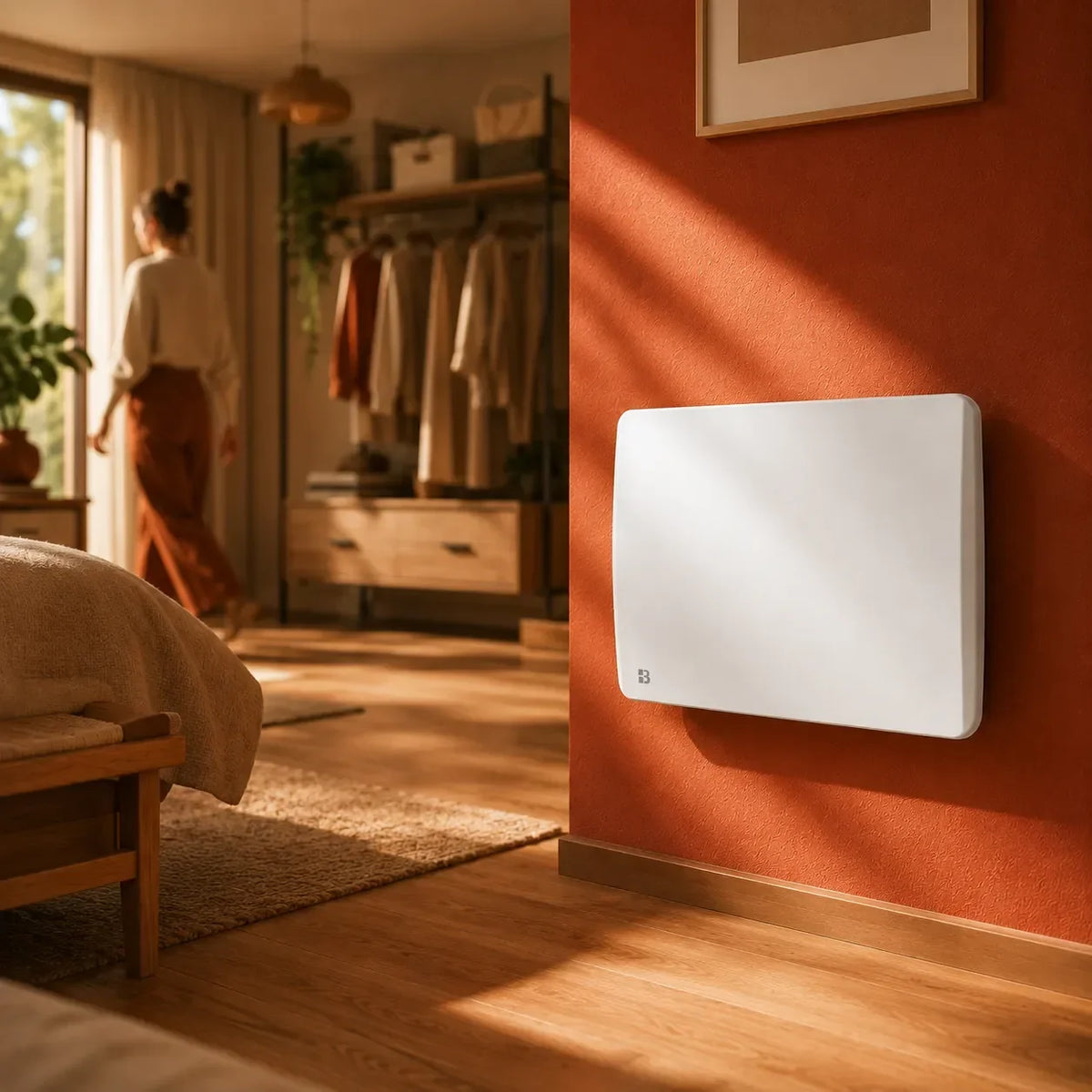
Choosing the right electric radiator is essential for enjoying a comfortable interior while keeping your energy costs under control. A model with insufficient wattage may run continuously without reaching the desired temperature, leading to excessive energy consumption. Conversely, an oversized radiator does not necessarily provide greater comfort and may cause temperature fluctuations.
What radiator wattage should you allow for per m²?
On average, you should allow for between 80 and 100 watts per m² in a properly or very well-insulated home. This estimate provides a basis for calculation that should be adapted to the characteristics of each property.
| Type of home | Recommended wattage per m² |
|---|---|
| Very well-insulated home (BBC, RE2020)* | Approximately 80 W/m² |
| Properly insulated home | Approximately 100 W/m² |
| Older or poorly insulated home | Up to 125 W/m² |
For example, for a 20 m² room in a properly insulated home, a wattage of around 2,000 W will generally be suitable. However, this value may vary depending on exposure, ceiling height and insulation level.
How do you calculate a radiator’s wattage based on room area?
The basic calculation is simple: Room area (m²) × wattage required per m² (W) = radiator wattage (W)
To choose a radiator that is perfectly suited to your needs, it is important to consider your property’s specific characteristics.
Which criteria affect a radiator’s wattage?
The room’s area is a useful starting point, but it alone cannot determine the ideal wattage. Several other characteristics of the property must also be taken into account:
- Home insulation: a recent, well-insulated home requires less wattage than an older property with significant heat loss.
- Geographical location**: heating needs are higher in cold regions or areas exposed to bad weather.
- Ceiling height: a room with a large air volume requires more wattage to be heated properly.
- Windows and glazing: large openings or poor insulation can increase heat loss.
- The room’s exposure: a north-facing room will generally require more wattage than a room that benefits from plenty of sunlight.
What wattage of radiator should you choose for each room?
The required power does not depend solely on the area to be heated. Each room has its own thermal comfort requirements depending on its use, volume, level of insulation and desired temperature.
What power rating should a radiator have in a bedroom?
The bedroom is generally heated to a lower temperature than living spaces to create a comfortable atmosphere conducive to rest.
For a 12 m² bedroom that is poorly insulated, a radiator of around 1,500 watts will be best suited to compensate for greater heat loss. However, this power rating should be adjusted according to several factors, such as the room's exposure, ceiling height, window quality and any heat loss.
To find out more, discover our advice on choosing a radiator suitable for a bedroom and enjoy optimal thermal comfort while keeping your energy consumption under control.
To improve everyday comfort and better control energy consumption, a connected electric radiator lets you schedule heating periods, adjust the temperature remotely and adapt heating to your lifestyle.
What power rating should a radiator have in a living room?
As the living room is occupied daily, it requires even heat distribution and a stable temperature throughout the day.
For a 25 m² living room that is properly insulated, a power rating of around 2,500 watts is therefore often recommended. In large rooms, distributing the power across several radiators helps spread the heat more effectively and limit cold spots.
The choice of technology and heating management mode also plays an important role. An smart electric radiator can provide additional comfort through personalised programming, automatic temperature management and operation optimised according to the home's actual needs.
Also, find our advice on choosing the right radiator for a living room to achieve even warmth throughout your living space.
What power rating should a radiator have in a bathroom?
The bathroom generally requires a higher temperature than other rooms to ensure comfortable conditions, particularly when showering or taking a bath.
For a very well-insulated 8 m² bathroom, an electric heated towel rail of around 750 watts may generally be sufficient. This power should be adjusted according to the room’s volume, the desired temperature, and the level of comfort sought.
In addition to heating, a heated towel rail provides extra comfort by ensuring you can enjoy dry, pleasant towels every day. Also discover our tips for choosing the right heated towel rail for your bathroom.
Should you choose a more powerful radiator for better heating?
Choosing a more powerful radiator is not always the best solution. The main objective is to select a unit with power suited to the room’s size and characteristics, ensuring optimal thermal comfort while keeping energy consumption under control.
An undersized radiator will struggle to reach the desired temperature. It will need to run for longer, or even continuously, to compensate for heat loss, which can lead to excess energy consumption and a feeling of discomfort.
Conversely, a radiator that is too powerful is not necessarily more economical. It can cause greater temperature fluctuations and less consistent operation.
Proper sizing therefore helps achieve the best balance between power, thermal comfort, and energy savings.
Which radiator technology should you choose?
Power is an essential criterion when choosing a radiator, but it is not enough to determine the level of comfort achieved. Heating technology also plays an important role in how quickly the temperature rises, how heat is distributed, and how well the radiator can maintain a pleasant temperature in the room.
The main technologies available are:
- Ceramic inertia radiator : ideal for rooms where gentle, even warmth is desired, a ceramic inertia radiator gradually stores heat before releasing it steadily. It provides stable comfort while limiting temperature fluctuations.
- Cast-iron inertia radiator: for lasting warmth, a radiator with a cast-iron heating core offers excellent heat-storage capacity. Cast iron gradually releases heat, even after the heating is switched off, for long-lasting thermal comfort.
- The dual-heating-core radiator: models equipped with dual-heating-core technology combine the responsiveness of a heating element with the performance of a dry-inertia heating core (ceramic or cast iron). They therefore heat up quickly while maintaining comfortable, even warmth in the room.
The choice of technology therefore depends on your priorities: heating a room quickly, enjoying gentle and consistent warmth, or optimizing your daily consumption. Also discover our energy-efficient electric radiators to find the solution best suited to your home and save on energy costs.
Mistakes to avoid when choosing a radiator’s output
When choosing an electric radiator, certain mistakes are common:
- Relying solely on the room’s floor area.
- Neglecting insulation quality.
- Choosing a radiator that is too weak to reduce the purchase price.
- Installing a single very powerful radiator in a large room without considering heat distribution.
Proper sizing improves comfort while optimizing energy consumption.
FAQ: What radiator output per m² is needed?
How many watts per m² are needed for an electric radiator?
In a properly or very well-insulated home, an output of between 80 and 100 watts per m² is a good starting point for calculation.
This figure can vary depending on several factors: insulation quality, exposure, ceiling height, and the volume to be heated.
What radiator output is needed for a 20 m² room?
For a 20 m² room, you generally need a radiator with an output of between 1,500 and 2,500 watts.
This output mainly depends on the property’s insulation level, the room’s exposure, and the desired temperature.
How can I tell if my radiator is powerful enough?
A properly sized radiator should quickly bring the room to the desired temperature and then maintain stable warmth without running continuously.
If the room remains cold despite continuous operation, the installed output may be insufficient or heat loss may be too significant.
Do you need several radiators in a large room?
In a large room, several properly sized radiators provide better heat distribution than a single high-output unit.
This distribution improves thermal comfort, reduces temperature differences, and optimizes heating operation.
* https://www.ecologie.gouv.fr/politiques-publiques/labels-batiment-basse-consommation-renovation

