
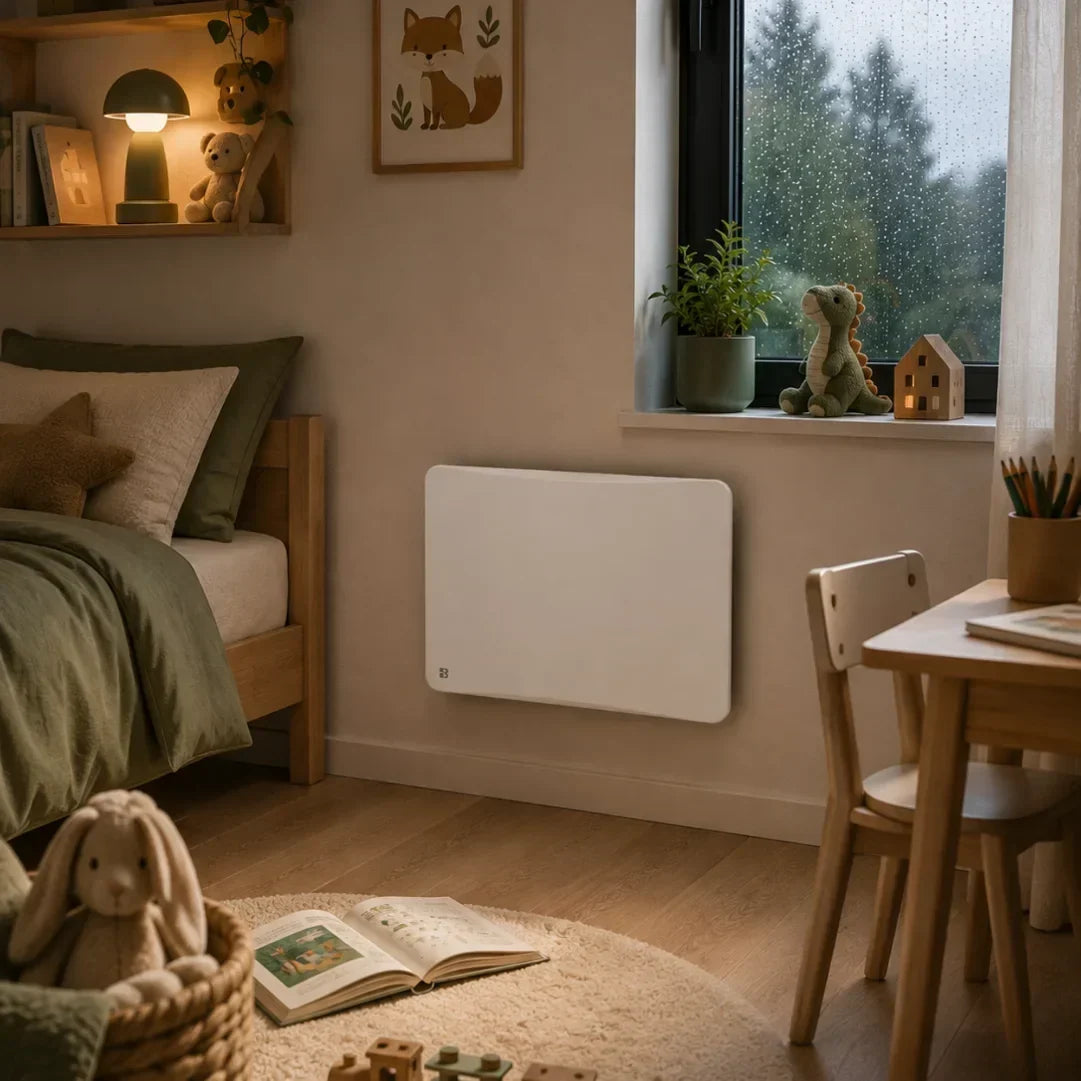
Choosing an electric radiator for a child's bedroom is not simply a matter of determining its power. Temperature, safety, regulation, and scheduling also contribute to everyday comfort.
Requirements also change with age: a baby's, child's, or teenager's bedroom will not necessarily have the same heating needs.
It is therefore necessary to consider the home, the desired comfort level, safety, and energy consumption together.
What heating should you choose for a child's bedroom based on their age?
The child's age is a useful starting point, but the home's layout and the family's habits also matter. The bedroom's size, exposure, and insulation quality can all affect requirements.
For a baby or infant, a stable and easy-to-control temperature is the main priority. With an older child, scheduling is useful for adapting the heating to the family's routine. During adolescence, controlling the heating according to occupancy times can provide greater flexibility.
An accurate thermostat makes it possible to adjust the temperature to the room's actual needs, rather than running the heating continuously.
What is the ideal temperature for a child's bedroom?
The recommended temperature depends in particular on the child's age and the time of day. According to ADEME*, a child's bedroom can be heated to 19°C when occupied during the day and to 17°C at night. These guidelines make it possible to heat according to occupancy periods and limit energy costs.
For a baby, the recommendations are slightly different. The Ministry of Health** recommends maintaining the bedroom temperature between 18°C and 20°C while the baby is sleeping. It is therefore preferable to take the child's age into account rather than applying a single temperature to every bedroom.
The aim is to avoid overheating while maintaining a comfortable, consistent temperature. The quality of the home, the actual measured temperature, and living conditions can also affect perceived comfort.
What radiator power should you choose for a child's bedroom?
Choosing the right power is just as important as choosing the radiator technology. An undersized appliance may need to run longer to reach the desired temperature, while excessive power can result in longer heating cycles.
The surface area is a useful starting point, but it is not enough to determine the required power. Ceiling height, exposure, and the characteristics of the home can also affect requirements. Two bedrooms of the same size may therefore require different power levels.
How do you calculate the required wattage?
For an initial estimate, you can use approximately 100 W per m² in a properly insulated home. This guideline can then be adjusted according to the characteristics of the home and the room.
In a recent building with very good thermal performance, particularly one rated BBC*** or compliant with the RE2020 standard****, requirements may fall to around 60 to 80 W per m². Conversely, an older home may require higher wattage.
Large windows, north-facing exposure, or a bedroom located in the attic should also be taken into account. The table below provides an initial estimate based on the level of insulation:
| Insulation level | Indicative wattage | Example for a 10 m² bedroom |
|---|---|---|
| Very good insulation | 60 to 80 W/m² | 600 to 800 W |
| Adequate insulation | Around 100 W/m² | Around 1,000 W |
| Average insulation | 100 to 120 W/m² | 1,000 to 1,200 W |
| Poor insulation | 120 to 150 W/m² | 1,200 to 1,500 W |
These figures provide an initial estimate and do not replace a precise heat-loss calculation. For a properly insulated 10 m² bedroom, a radiator of around 1,000 W is a reasonable starting point. A less well-insulated room may require higher wattage.
What criteria should you use to choose a safe radiator?
For a child’s bedroom, safety does not rely on a single feature. The choice of a child-safe radiator, its equipment, and above all the quality of its installation must be considered together.
The elements to check include:
- a thermostat for controlling the temperature;
- Overheating protection when provided by the manufacturer;
- a control lockout device, particularly useful for preventing accidental operation by children, on models that have one;
- an protection rating suited to the environment;
- the certifications and standards applicable to the product, such as the NF Électricité standard*****;
- an installation that complies with the manufacturer’s recommendations.
Therefore, choose an appliance suited to the room, equipped with appropriate safety features, and installed in accordance with the manufacturer’s instructions.
How can you make the radiator installation safer?
Even a high-performance radiator must be installed correctly. Its location and the required clearances around the appliance are specified in the manufacturer’s instructions and must be followed carefully.
In particular, it is important not to place clothing, blankets, curtains, or furniture directly in front of or on the radiator. These items can obstruct heat distribution and, depending on the circumstances, create a risk.
For more information, see our electric radiator installation guide to learn about best practices and the precautions to take when installing your appliance safely.
A safe installation therefore rests on three elements: a suitable appliance, correct installation, and use in accordance with the manufacturer’s instructions.
Child-safe radiator: which features should you prioritize?
For a child’s bedroom, certain features can provide additional day-to-day safety. A radiator with control lock, in particular, helps prevent a child from accidentally changing the settings. Depending on the model and how it is used, overheat protection can also help make the appliance safer to operate.
For a child’s bedroom, the main considerations are choosing an appliance suited to the room and following the manufacturer’s installation instructions.
No radiator is completely “risk-free”: safety depends on the model chosen, its installation, and how it is used. It is therefore essential to keep the appliance unobstructed and not let a child handle the controls or unnecessarily approach the radiator while it is operating.
Why choose a dry-inertia radiator?
In a child’s bedroom, a dry-inertia radiator can provide even heat and stable regulation. Its heating element stores heat before releasing it gradually, while the thermostat allows you to set the desired level precisely.
At Bestherm, this technology is combined with electronic control designed to maintain consistent comfort.
Programming: an asset for controlling energy consumption
With weekly programming, the heating can follow the family’s routine rather than operating the same way all day.
In a child’s bedroom, this can mean planning for:
- a temperature suited to periods when the room is occupied;
- a reduced temperature at night;
- a reduced temperature during periods of absence;
- an increase in temperature before the child returns.
ADEME specifically recommends adapting heating to actual needs and highlights the benefits of a programmable thermostat for adjusting the temperature according to the time of day or week.
Bestherm radiators also offer control features that allow the heating to be adapted to the rhythm of the week.
How can you heat a child’s bedroom without consuming too much energy?
To reduce heating consumption in a child’s bedroom, the most effective solution is not necessarily to choose a less powerful radiator, but to prioritize a correctly sized appliance and regulation suited to occupancy schedules.
A few habits can make a difference on a daily basis:
- Adjust the temperature to the room’s occupancy.
- Use weekly programming.
- Avoid maintaining a high temperature when the room is unoccupied.
- Check the quality of the insulation and limit air infiltration.
- Do not place furniture, laundry or curtains in front of the radiator.
- Air the room regularly, remembering to turn off the heating while the windows are open.
All Bestherm radiators are equipped with open-window detection. If the temperature drops suddenly while airing the room, heating is temporarily stopped to avoid unnecessarily heating the room.
Smart radiators: an asset for regulation and consumption
A smart radiator offers more options for managing heating on a daily basis. A connected electric radiator can notably be controlled remotely from a mobile app to adjust the temperature or settings as needed.
This feature is particularly useful when schedules change or a child comes home earlier than expected. Depending on the model, it is also possible to monitor consumption in real time.
These features complement programming and offer greater flexibility when routines change.
Mistakes to avoid when heating a child’s bedroom
The choice of radiator matters, but how it is used also affects comfort and energy costs. In particular, avoid overheating the bedroom: a higher temperature does not necessarily improve comfort. It is better to set the thermostat to a suitable temperature and let the radiator automatically regulate the heat.
You should also avoid blocking heat distribution with furniture, laundry or curtains placed in front of the radiator. The model should not be chosen solely based on its price or power either: thermostat, programming, safety features and suitability for the room should also be taken into account.
Finally, the installation must comply with the clearances and recommendations specified in the manufacturer’s manual. For supplementary heating, usage precautions are also essential. A correctly sized, properly installed appliance with suitable temperature control can therefore maintain good comfort without heating unnecessarily.
FAQ – Heating a Child’s Bedroom
What is the ideal temperature in a child’s bedroom?
The recommended temperature is 19 °C during the day when the bedroom is occupied and 17 °C at night. For a baby, a temperature between 18 °C and 20 °C in the bedroom where they sleep is recommended.
These values are guidelines: the home’s insulation, the actual room temperature, and living conditions can affect perceived comfort. The key is to avoid overheating the bedroom.
Which safe radiator should you choose for a baby’s bedroom?
An electric radiator with precise temperature control can maintain a stable temperature in a baby’s bedroom. Safety and installation conditions are also essential.
Choose a model equipped with suitable safety features and always follow the manufacturer’s recommendations for installation and use.
Is a dry-inertia radiator suitable for a child’s bedroom?
Yes, this technology is suitable for a child’s bedroom. Its heating element releases heat gradually and, combined with precise temperature control, helps maintain a stable temperature.
Scheduling makes it possible to adjust heating periods to periods when the room is occupied, when the child is sleeping, and when it is unoccupied, avoiding unnecessary heating and helping save energy.
How can a radiator be installed safely in a child’s bedroom?
To install a radiator safely in a child’s bedroom, follow the clearances recommended by the manufacturer and do not place any furniture, textiles, or objects on or in front of the appliance. Installation in accordance with the manual helps limit risks and ensures the heating operates properly.
Depending on the model, features such as overheating protection or control locking can provide additional safety. The recommendations provided in the manual must always be followed.
Can the heating in a child’s bedroom be programmed?
Yes, a programmable heater automatically adjusts the temperature to periods when the room is occupied, when the child is sleeping, and when it is unoccupied. This avoids heating the bedroom unnecessarily while maintaining suitable comfort.
A weekly schedule can, for example, set different heating periods depending on the day, which is useful when a child’s schedule varies between weekdays and weekends.
*** https://www.ecologie.gouv.fr/politiques-publiques/labels-batiment-basse-consommation-renovation
**** https://www.ecologie.gouv.fr/politiques-publiques/reglementation-environnementale-re2020

