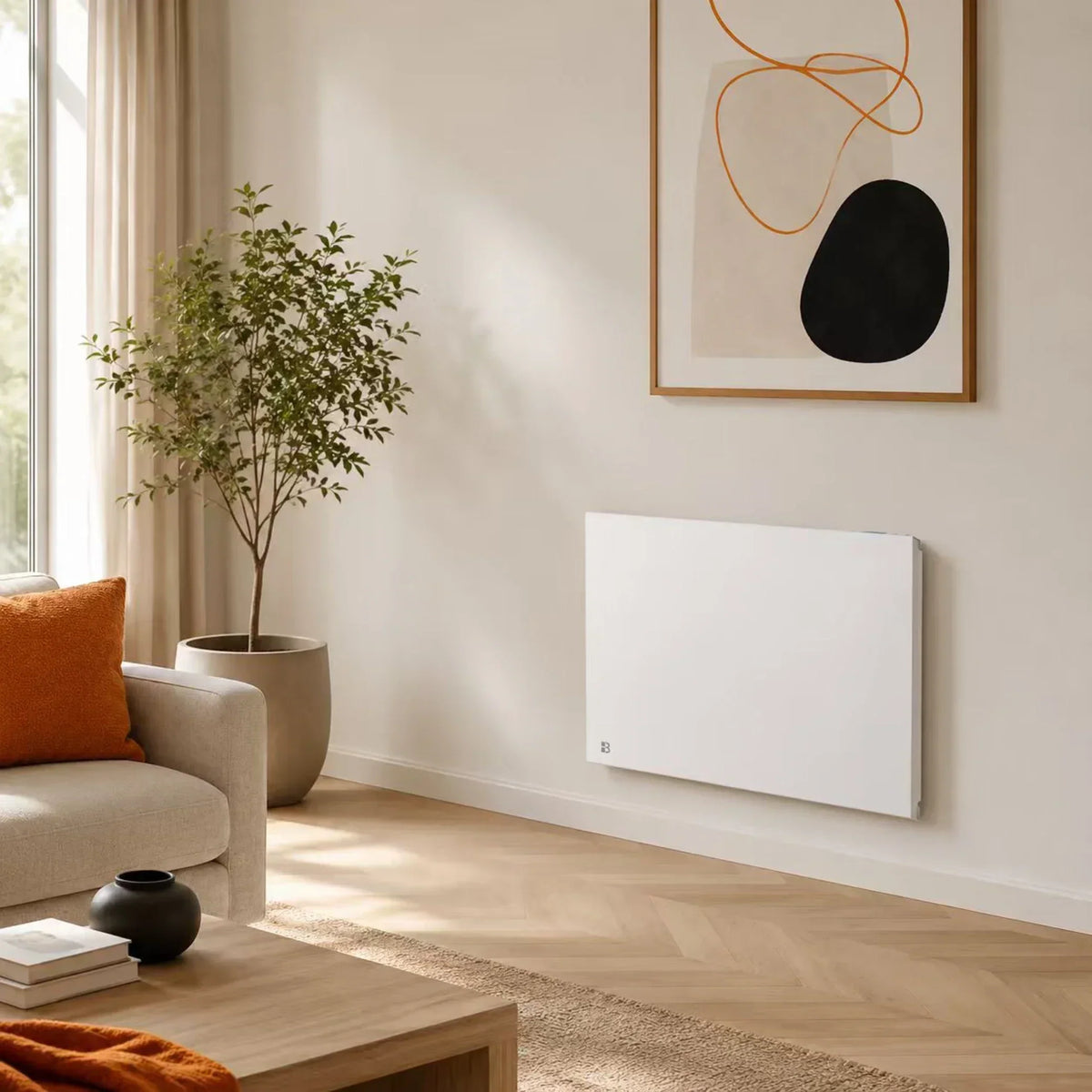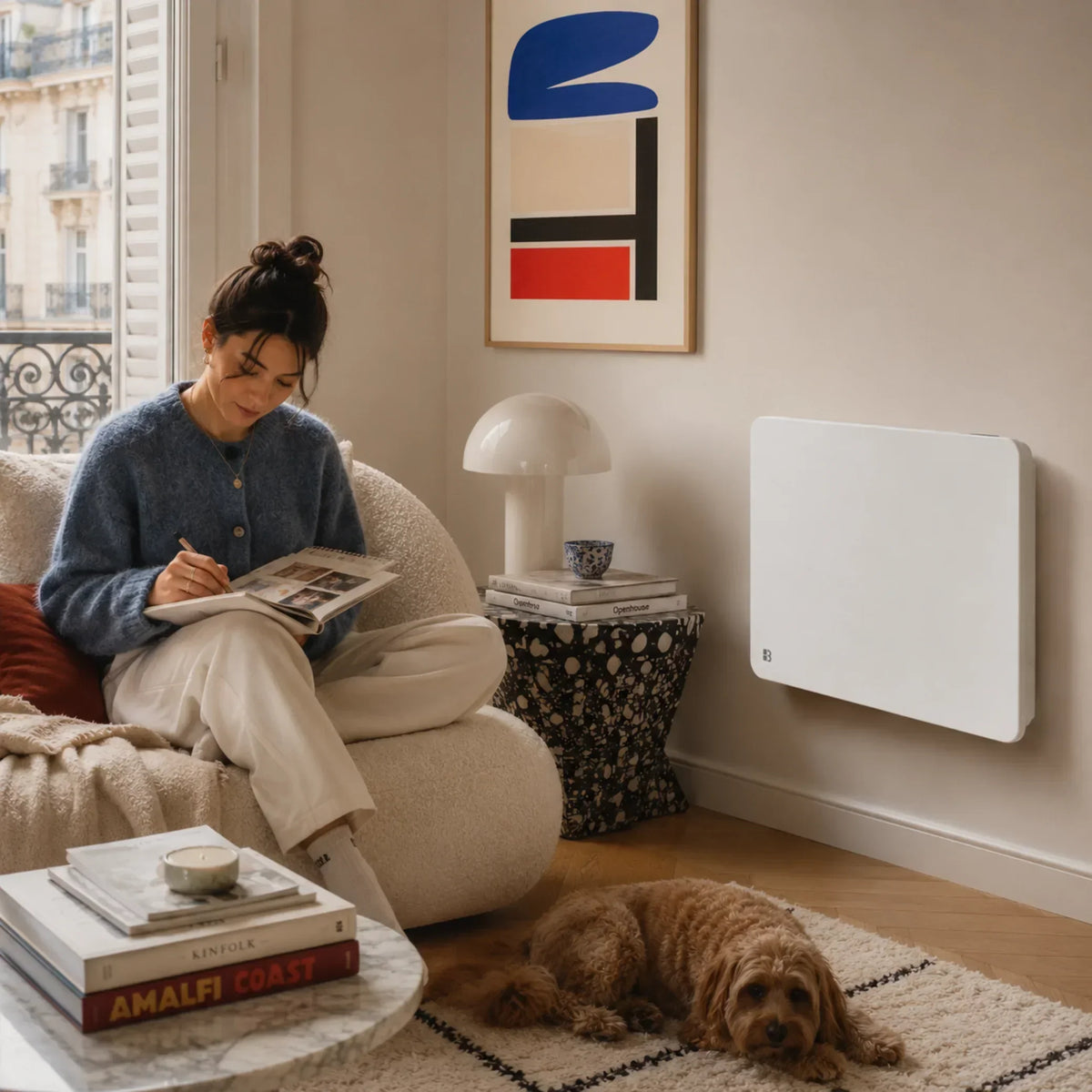
The electric radiator remains a heating solution suited to both new homes and renovation projects. Easy to install and available in a wide range of formats, it now combines thermal comfort, design and control over energy consumption.
Technology has also evolved significantly. Older convectors have gradually given way to more efficient models, particularly dry-inertia radiators equipped with an electronic thermostat.
But with all the models and features available, which radiator should you choose? Let’s take a look at the main technologies and the criteria to consider before equipping your home.
1. The different types of electric radiators.
Not all electric radiators provide the same sensation of warmth. Their technology mainly influences how heat is distributed and regulated.
The electric convector
The convector quickly heats the air using an electric heating element. Warm air rises, while cooler air descends toward the unit.
Simple to use and responsive, the convector nevertheless has low thermal inertia. Once the heating element is switched off, it does not store heat for later release. It may be suitable for a room that is rarely occupied or for occasional use, but it is less suited to heating a living area every day.
The radiant panel
The radiant panel uses a heating element that heats a plate and distributes part of the heat through infrared radiation.
The heat you feel is more direct than with a convector. It can therefore be useful for heating a room quickly. However, the radiant panel stores little heat once the heating element is switched off.
The dry-inertia radiator
The dry-inertia radiator incorporates a solid heating core, generally made of ceramic or cast iron. It stores the heat produced by the heating element before gradually releasing it.
Heat is therefore distributed more gradually and evenly, improving everyday comfort. With a precise electronic thermostat, the radiator can also adjust its heat output to maintain the desired temperature.
| Technology | Type of heat | Heat retention | Electricity consumption | Recommended use |
|---|---|---|---|---|
| Electric convector | Convection | Very low | High | Occasional heating |
| Radiant panel | Direct radiation | Low | Moderate | Rapid heating |
| Dry-inertia radiator | Gentle, even heat | Long-lasting | Optimized by regulation | Daily heating, all rooms |
Please note: consumption depends on several factors, including the radiator's power, the home's insulation, the selected temperature, heating time, and the room's exposure.
2. Which electric radiator should you install in each room of the house?
The choice of radiator also depends on the room to be heated. The requirements are not the same in a living room, bedroom, or office.
Living room and lounge: prioritize stability
In a living room, heating is often used for several hours a day. A dry-inertia heater is well suited to this use, particularly for maintaining a stable temperature and consistent heat.
A high-inertia radiator provides consistent heat, while the electronic thermostat maintains the desired temperature.
Bedroom: quietness and controlled temperature
In a bedroom, comfort is primarily about stability and quietness. A temperature of around 17 °C is generally sufficient for comfortable sleep.
The radiator must therefore be quiet, easy to program, and able to maintain a steady temperature without significant fluctuations.
For more information, see our guide to choosing suitable heating for a child's bedroom.
Office: responsiveness and programming
An office is generally occupied during specific time slots. This is where time programming becomes particularly useful.
Presence detection can also be useful in an office, especially when occupancy hours vary.
Presence detection can also be useful in an office, especially when occupancy hours vary.
3. How do you calculate the power required for your rooms?
Choosing the wattage is essential. An undersized radiator may run for longer without properly reaching the desired temperature. Conversely, excessive power does not necessarily provide greater comfort.
For a standard ceiling height of approximately 2.50 m, a common initial estimate is to allow for approximately 100 W/m² in a normally insulated home.
For example, for a 20 m² room: 20 × 100 W = 2 000 W
This estimate must, however, be adapted to the characteristics of the home.
- Older or poorly insulated home: approximately 125 to 150 W/m²
- Moderately insulated home: approximately 100 W/m²
- Recently built, well-insulated home: approximately 70 to 80 W/m²
The room's exposure, ceiling height, climate zone, windows and doors, and insulation quality must also be taken into account.
To find out more, see our guide to accurately calculating the power required per m².
4. Modern technologies: scheduling and smart control
Today, an electric radiator can do much more than simply provide heat. Scheduling, presence detection and smartphone control make it possible to adapt its operation to the household's routine.
Some connected radiators feature Wi-Fi connectivity. From a mobile app, you can adjust the temperature, schedule heating periods or control your system remotely. Depending on the model, you can also monitor your consumption in real time.
Several functions can also help prevent unnecessary heating:
- Time programming based on your lifestyle;
- Remote control from a mobile app;
- Presence detection depending on the model;
- Open-window detection: particularly when there is a sudden drop in temperature;
- Comfort, Eco, Frost Protection or Standby modes depending on the model.
The idea is simple: heat when necessary, to the right temperature, and avoid running the heating unnecessarily. This way, you enjoy greater comfort while keeping better control of your energy consumption.
5. Replacement and renovation: successfully transitioning to modern heating
Good news if you are renovating: replacing old electric radiators generally does not require major work. In many cases, the operation simply involves removing the old appliance and installing the new one on its wall bracket.
Before any work, however, it is essential to check the installation's compatibility and comply with the electrical regulations in force. If in doubt, call on a qualified professional.
For an energy-efficiency renovation, replacing old appliances with radiators equipped with effective electronic regulation can improve comfort and heating control.
FAQ: frequently asked questions about electric radiators
Which electric radiator is the most economical to run?
The dry-inertia electric radiator is one of the most attractive solutions for controlling daily energy consumption. Its ceramic or cast-iron heating core stores heat and releases it gradually.
At equivalent output, an inertia radiator does not inherently consume less electricity. The savings mainly depend on good regulation, a suitable temperature and programming that avoids heating when it is not necessary.
What electric radiator output should you plan for per m²?
The standard calculation rule allows for 100 watts per square metre for a moderately insulated home with a ceiling height of 2.50 m.
In a recent, very well-insulated home, 70 to 80 watts per m² can provide an initial estimate. However, the actual requirement depends on the characteristics of the property.
Should you leave an electric radiator running all day?
There is no need to heat to the same temperature all day. During a temporary absence, an Eco mode around 16 to 17 °C can lower the temperature without switching the heating off completely.
A suitable schedule then makes it possible to return to a comfortable temperature at the desired time.