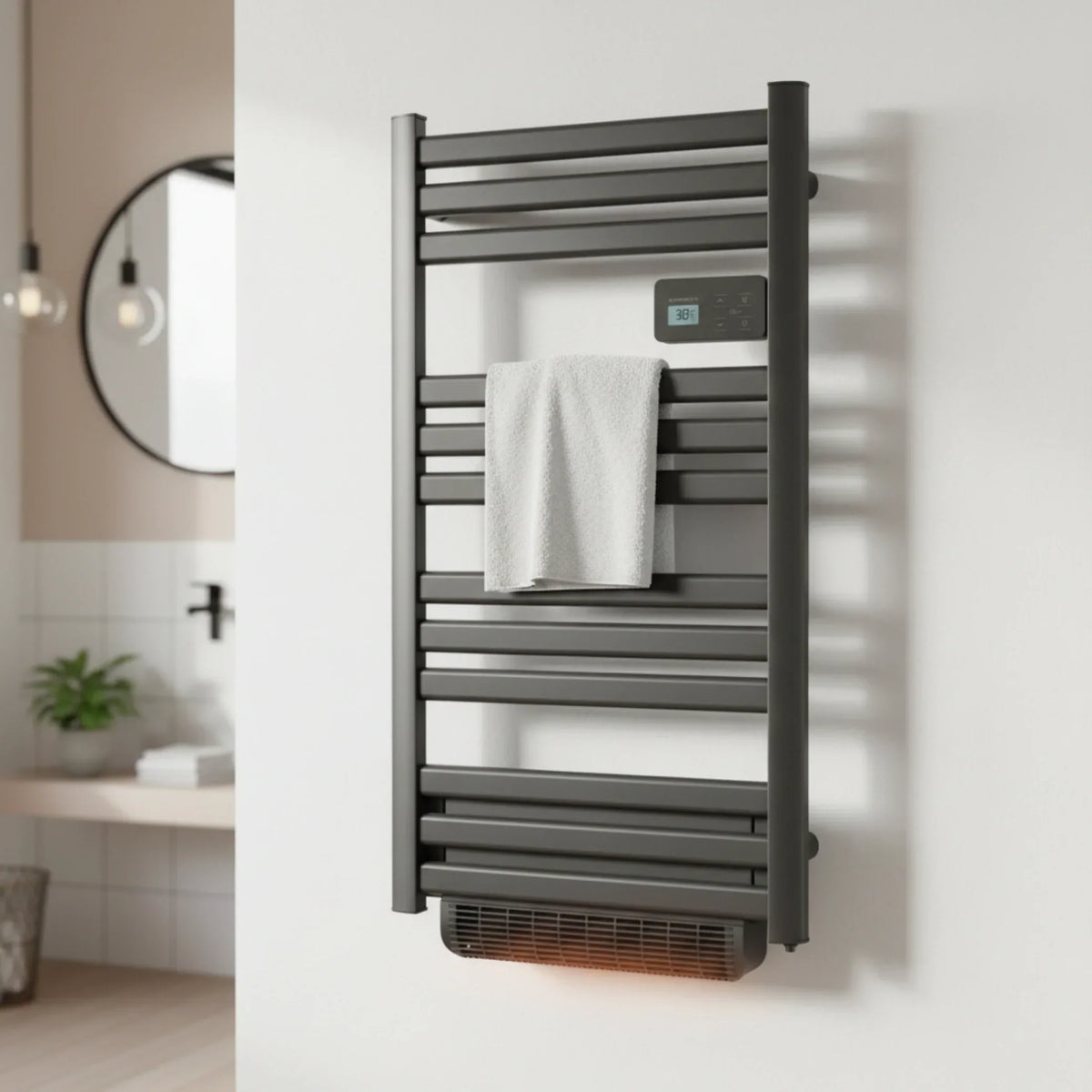
A connected towel radiator is not only used to keep your towels warm. Thanks to Wi-Fi and a mobile app, you can schedule heating periods, adjust the temperature remotely, and enjoy a comfortable bathroom when you need it.
But what power rating should you choose? Which technology should you prefer: a fluid-free model or a fluid-filled towel radiator? And above all, does connectivity offer a real everyday benefit? Here are the main points to know before making your choice.
To discover the different models available, see our selection of high-end electric towel radiators.
1. Why choose a connected towel radiator for your bathroom?
The bathroom does not need to be heated all day. In most homes, it is mainly used in the morning and evening, when showering or taking a bath.
The benefit of a connected towel radiator is precisely that you can adapt the heating to these times. For example, you can program your appliance to start heating a few minutes before you wake up. When you arrive in the bathroom, the room is already at a comfortable temperature and the towels are ready.
Once the heating period is over, the appliance can automatically return to its program. This prevents you from heating an empty room for several hours.
Remote control is also convenient when your habits change. A day working from home, a later shower, or an unexpected return home: a few adjustments from your smartphone are enough to adapt the towel radiator's operation.
The benefit of connected heating is ultimately quite simple: you heat the bathroom when you need it, without leaving the appliance running unnecessarily.
Bestherm connected heating solutions combine ease of use, comfort, and personalized temperature control.
2. Key features of a smart towel radiator
A connected towel radiator offers more ways to manage the temperature according to your habits.
Wi-Fi control and mobile app
Once connected to your Wi-Fi network, the appliance can be controlled from a compatible mobile app. You can adjust its operation without having to walk over to the radiator.
Has your schedule changed? You can simply adjust the heating periods from your smartphone without having to operate the appliance directly.
Weekly scheduling
With weekly scheduling, you can set your heating times according to your routine. The appliance then automatically follows the selected schedule, so you do not have to think about it every day.
The Boost function and built-in fan
Need heat before your shower? The built-in fan provides an extra boost of heat within minutes, quickly warming the room. This is particularly useful in winter, when the bathroom is cooler in the morning.
Discover our towel radiators with built-in fans to enjoy this feature.
Window-open detection
Depending on the model, a window-open detection function may also stop heating when a sudden drop in temperature is detected.
This feature prevents unnecessary heating when the window is open to air the room.
3. Towel radiator without fluid or with fluid: which technology should you choose?
Not all towel radiators distribute heat in the same way. The choice of heating element particularly affects the speed at which the temperature rises and heat retention.
A dry-inertia towel radiator (without fluid) has an electric heating element built directly into its front panel or heated bars. It responds quickly, and the heat continues to be distributed evenly, including after the heating element has switched off.
A fluid-filled towel radiator (with heat-transfer fluid) works differently: a heating element heats a heat-transfer fluid, which then transfers the heat to the body of the appliance. The temperature generally rises more gradually.
| Technology | Operating mode | Heating time | Heat retention | Risk of leakage |
|---|---|---|---|---|
| Without fluid | Built-in heating element | Fast | Immediate | None |
| With fluid | Heat-transfer fluid | Progressive | Progressive | Long-lasting |
The choice therefore depends mainly on your habits: a fluid-free model prioritizes rapid heating, while a fluid-filled model provides gradual, even heat distribution.
4. What power should you choose based on the size of your bathroom?
The room’s surface area provides an initial indication when choosing the power of your towel warmer. But insulation matters just as much: a well-insulated bathroom will require less power than a cold or poorly insulated room.
For a very well- to well-insulated bathroom, you can use a baseline of approximately 100 W per m². The power should then be adjusted according to the room’s layout and the desired level of comfort.
The Bestherm range offers several configurations to meet these needs:
- Under 5 m²: a 300 or 500 W model may be suitable for a very well- or well-insulated bathroom.
- From 5 to 7 m²: generally choose 500 or 750 W, depending on the room’s insulation.
- Over 7 m²: a 750 W model may be suitable for a well-insulated room.
- Need a rapid temperature increase: the 500 + 1 000 W and 750 + 1 000 W models combine towel-warmer heating with a built-in 1 000 W fan heater. The fan heater quickly provides additional warmth, particularly before a shower.
These values are for guidance only. Ceiling height, windows, insulation, and the desired temperature can also affect requirements.
Finally, power alone is not enough to determine electricity consumption. It also depends on the operating time and the temperature selected. With programming, a connected towel warmer can operate only during the time slots that actually match your habits.
To learn more, discover how to calculate your appliances’ electricity consumption as accurately as possible and better manage your heating day to day.
5. Installation and safety standards in wet rooms
Installing an electric appliance in a bathroom requires a few precautions. In particular, the location of the towel warmer must be chosen according to the room’s various safety zones and the electrical regulations in force.
L'IP24 rating indicates that the appliance is protected against water splashes. This is an important feature for installation in a damp room, but it does not mean that the towel rail can be placed anywhere.
Before installation, check the requirements applicable to your bathroom and observe the safety distances. If in doubt, it is best to call on a qualified professional to determine the appropriate location and carry out the connection.
FAQ: everything you need to know about connected towel rails
How does a connected towel rail work?
A connected towel rail connects to Wi-Fi and can be controlled from a mobile app. Depending on the model, you can schedule heating times, change the settings remotely, or activate Boost mode.
How much energy does a connected towel rail use?
Consumption depends on the towel rail's power rating, but also on how long it operates. Connectivity mainly helps you manage these heating periods more effectively through scheduling and remote control.
However, there is no universal percentage of savings: the results depend on usage habits, the insulation of the home, and the selected temperature.
What power rating should you choose for a towel rail for 5 m²?
For a 5 m² bathroom, a 500 W model may be suitable when the room is very well or well insulated. If the insulation is less effective, a 750 W model will be more suitable. The 500+1000 W or 750+1000 W models also let you use a fan heater to quickly provide additional heat.
Connected towel rail: is it really useful?
Yes, particularly if you want to adapt the heating to your lifestyle. Scheduling, remote control and, depending on the model, the Boost function allow you to enjoy greater comfort while avoiding running the appliance unnecessarily.
What is the best choice between a fluid-free towel rail and a fluid model?
For regular use, dry inertia offers a good combination of responsiveness and gradual heat release. Fluid inertia remains an attractive alternative for those looking for gentle, even heat distribution.
The best choice therefore depends above all on your habits, the size of your bathroom, and the level of comfort you are looking for.